Spanish Civil War 1936–1939
Part 14 1938
(dates below refer to publication dates)
February 12 th to March 19th 1938
Illustrated London News Collection
A curated collection of ILN reports and images covering the Spanish Civil War — political background, major battles and key personalities.
The Spanish Civil War (1936–1939) began with a military uprising against the Republican government in July 1936. The conflict rapidly polarised Spanish society and drew international attention — the Nationalists (led by Francisco Franco) were supported by Fascist Italy and Nazi Germany, while the Republicans received aid from the Soviet Union and volunteers from the International Brigades. The war reshaped Spain and had wide-reaching cultural and political consequences across Europe.
On this page you will find ILN scans, captions, short biographies, and selected contextual notes to help readers understand the events and principal actors.
Key figures (brief)
- Francisco Franco — Leader of the Nationalist rebels, later head of state of Spain.
- Manuel Azaña — President of the Spanish Republic (during key periods of the war).
- Dolores Ibárruri (La Pasionaria) — Prominent Republican speaker and symbol of Republican resistance.
- International Brigades — Volunteers from many countries who fought for the Republic.
- General Emilio Mola — One of the main plotters and Nationalist commanders (died 1937).
- Buenaventura Durruti — Anarchist leader who played a role on the Republican side.
(Names and roles are documented in ILN coverage and standard histories of the conflict.)
Key Events
-
July 17-18, 1936 — Military uprising begins
A coup by parts of the military against the Second Spanish Republic starts the civil war. Wikipedia+2spanishcivilwar.ca+2 -
July-Sept 1936 — Nationalists seize large areas
The rebel forces quickly take control of areas like Seville, parts of Morocco, and large swathes of western/central Spain. History of Spain+1 -
Late 1936 — Siege of Madrid and international aid begins
The battle for Madrid becomes symbolically important. Meanwhile the rebel side receives increasing foreign support (Germany, Italy) and the Republic receives Soviet aid. Homeschool Spanish Academy+1 -
April 26, 1937 — Bombing of Guernica
German and Italian air forces bomb the Basque town of Guernica, showing the war’s brutality and foreign involvement. Homeschool Spanish Academy+1 -
Spanish Civil War, 1938
-
January 1938
-
Battle of Teruel continues:
Republicans hold much of the city in bitter winter fighting, but Nationalists counterattack. -
Extreme cold causes significant casualties on both sides.
February 1938
-
Nationalists recapture Teruel (22 February).
A major blow to Republican morale and resources. -
Franco launches a renewed Aragon offensive.
March 1938
-
Aragon Offensive:
Nationalists break through weakened Republican lines. -
Rapid Nationalist advance to the Mediterranean:
Franco’s armies cut Republican Spain in two by reaching Vinaroz about (15 April). -
Republican zones are now split into northern Catalonia and central–southern Spain.
April 1938
-
Nationalists consolidate control of eastern Aragon and the Levante coast.
-
Franco begins planning a major offensive on the River Ebro after consolidating Aragon,
May 1938
-
Bombing of Alicante (25 May) causes large civilian casualties.
-
Fighting intensifies around Valencia as the Nationalists attempt to take the city.
June 1938
-
Collapse of the Republican line around Castellón:
Nationalists capture Castellón de la Plana (14 June). -
Republican forces retreat toward Valencia.
July 1938
-
Start of the Battle of the Ebro (25 July):
The Republic launches its last major offensive, crossing the Ebro River in a surprise attack. -
Initial Republican gains are significant, but Nationalist air superiority soon takes effect.
August 1938
-
Battle of the Ebro intensifies:
Heavy attrition on both sides; Condor Legion and Italian aircraft dominate the skies. -
Republicans struggle to supply forces across the river.
September 1938
-
International Brigades withdrawn by the Republican government (21 September) in an attempt to gain diplomatic favour.
-
Nationalist counteroffensive slowly pushes Republicans back.
October 1938
-
End phase of the Battle of the Ebro:
Nationalists retake most lost territory. -
Republican troops begin a fighting withdrawal.
November 1938
-
Battle of the Ebro ends (16 November):
Decisive Nationalist victory, leaving the Republic exhausted and critically weakened. -
Franco prepares his final offensive against Catalonia.
December 1938
-
Nationalist Catalonia Offensive begins (23 December):
Massive attack toward Barcelona. -
Republicans unable to hold positions; retreat begins across Catalonia
-
Who Were the Rebels?
The Rebels — later known as the Nationalists — were led by General Francisco Franco and other senior officers who rose in July 1936 against Spain’s elected Popular Front government, the left-wing administration of the Second Spanish Republic. Their ranks included much of the regular army, particularly units from Spanish Morocco, together with monarchists, conservatives, and members of the Falange (Spain’s fascist movement). They received crucial support from Nazi Germany, Fascist Italy, and Portugal.
The opposing Republicans comprised socialists, communists, anarchists, and regional nationalists, supported by the Soviet Union and the International Brigades of foreign volunteers.
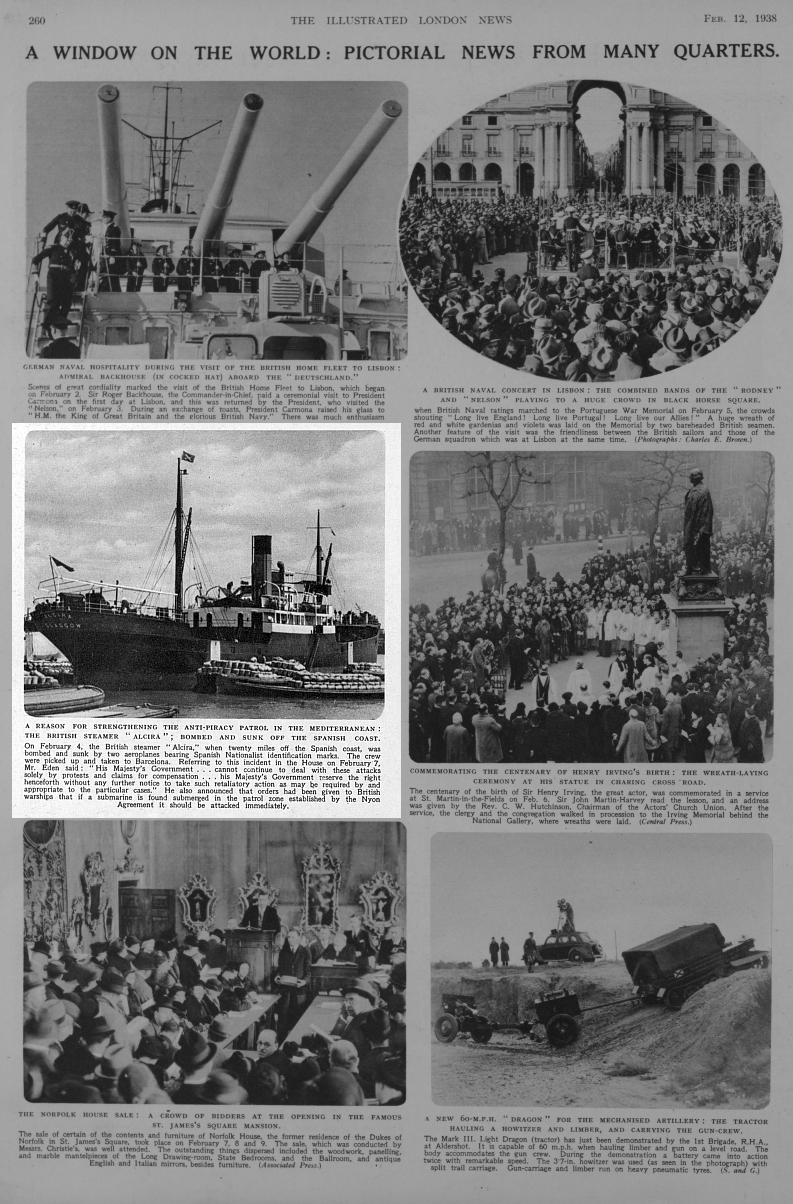
Strengthening the anti piracy patrol in the Mediterranean February 12th 1938
The British steamer "Alcira" was bombed and sunk off the spanish coast
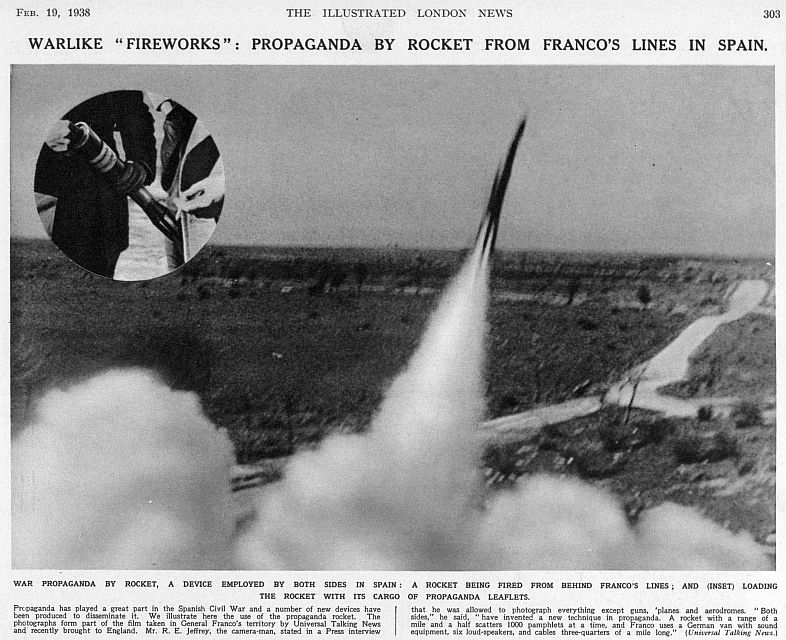
A rocket from Franco with a cargo of propaganda leaflets February 19th 1938
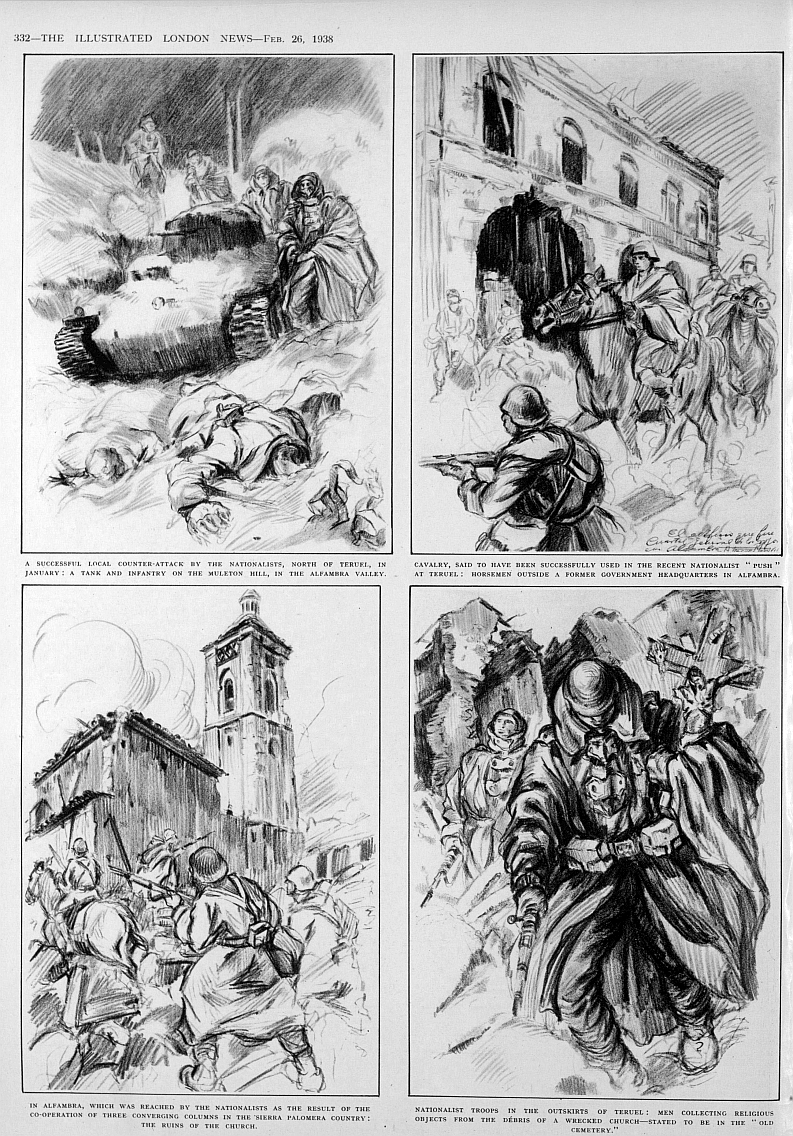
The nationalists in the Alhambra valley February 26th 1938
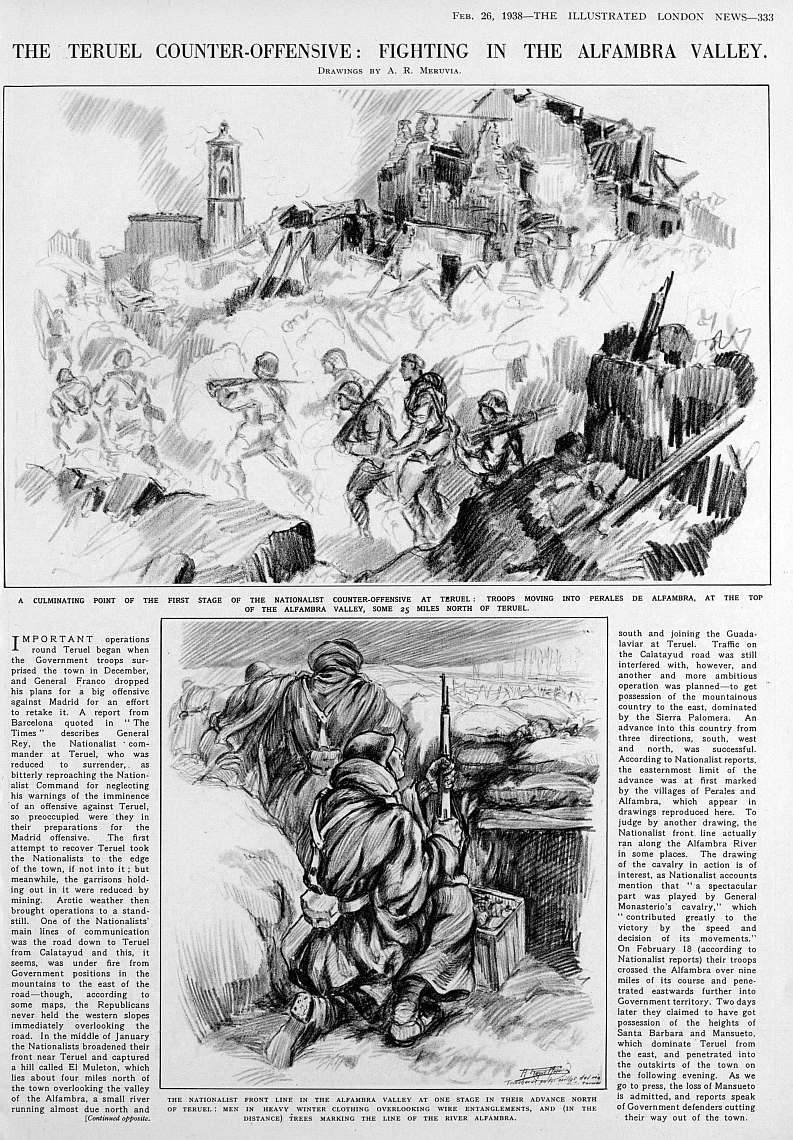
In the Alhambra valley with artist A.R. Meruvia
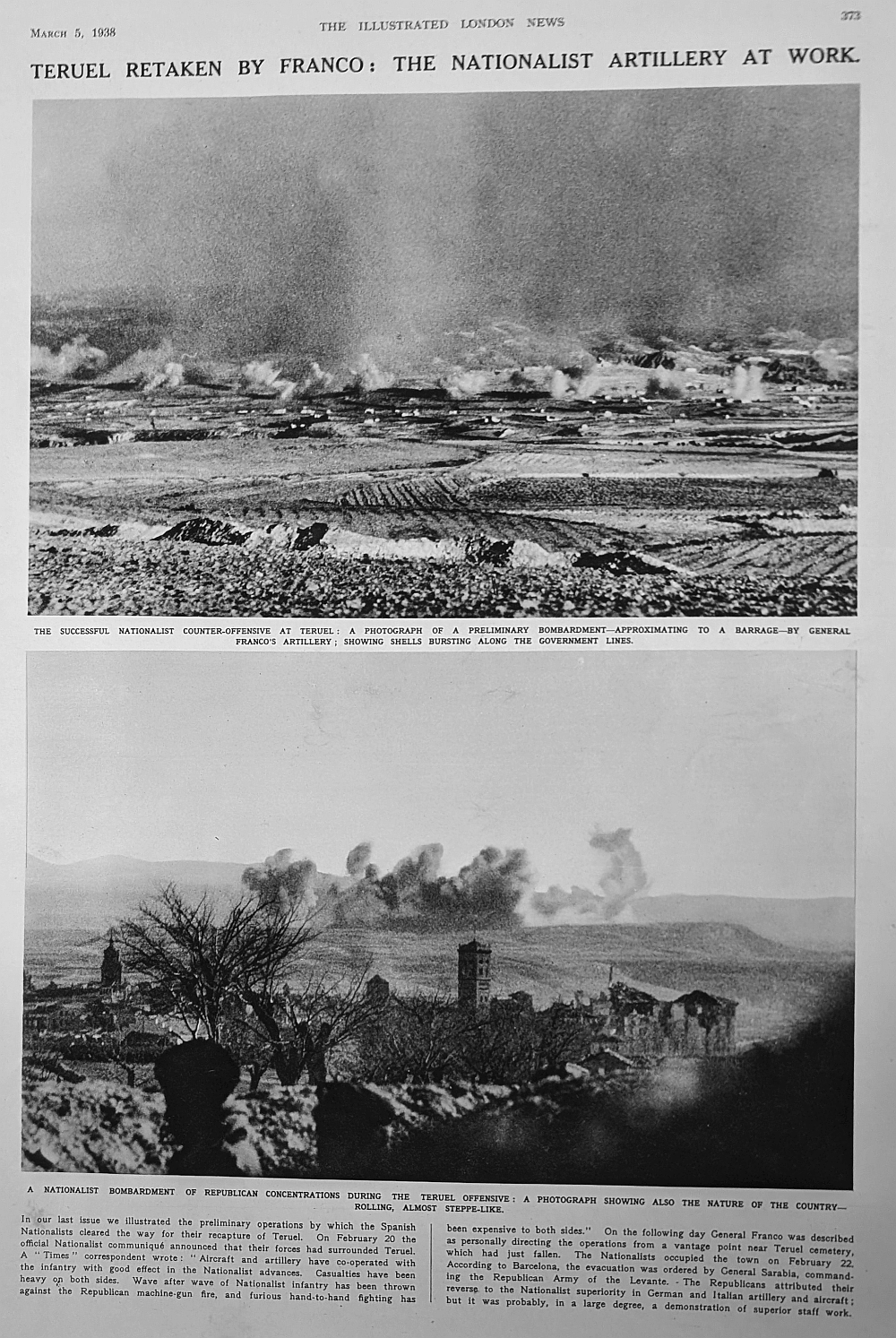
Teruel retaken by Franco
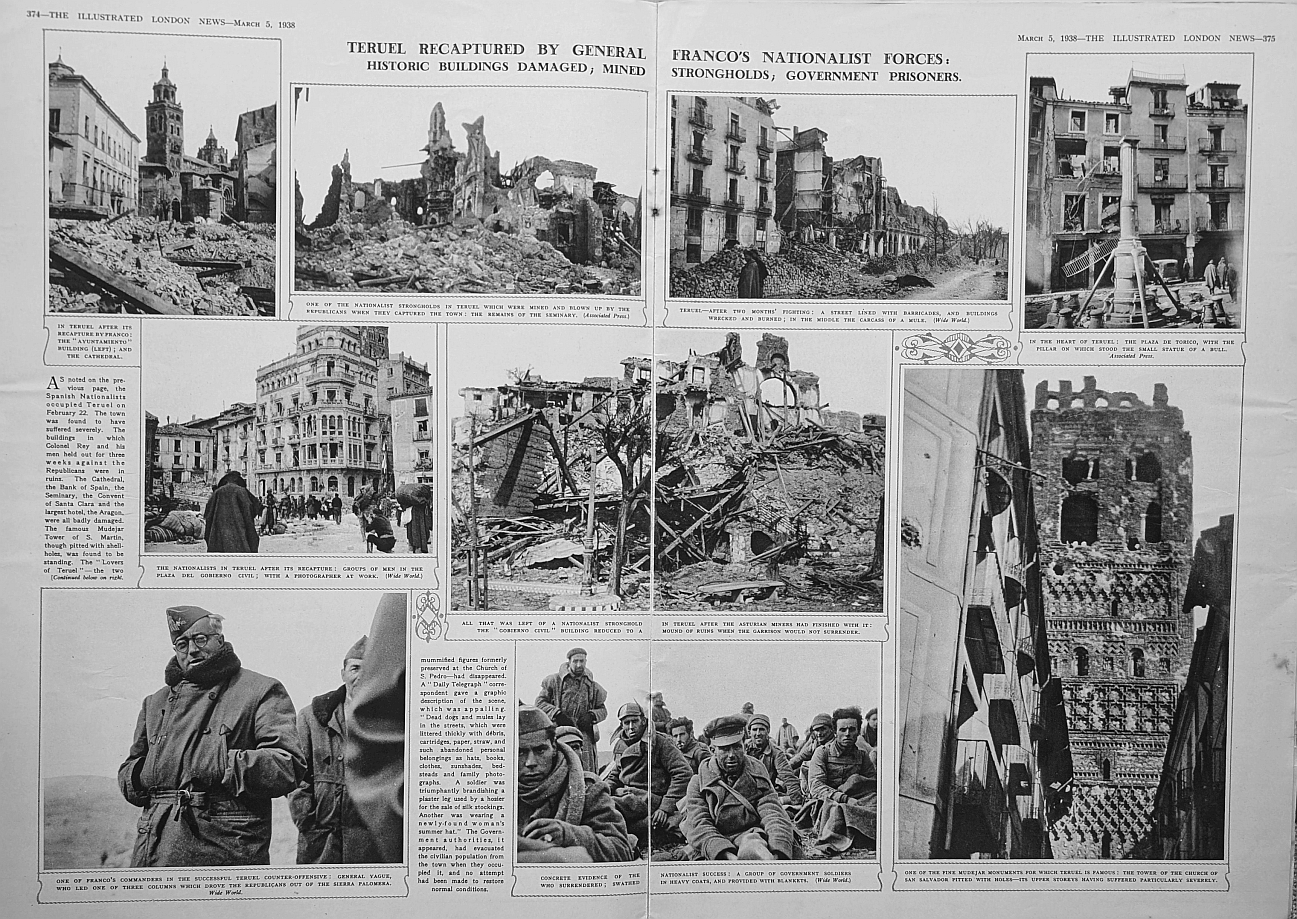
Teruel retaken by General Franco's Nationalist forces
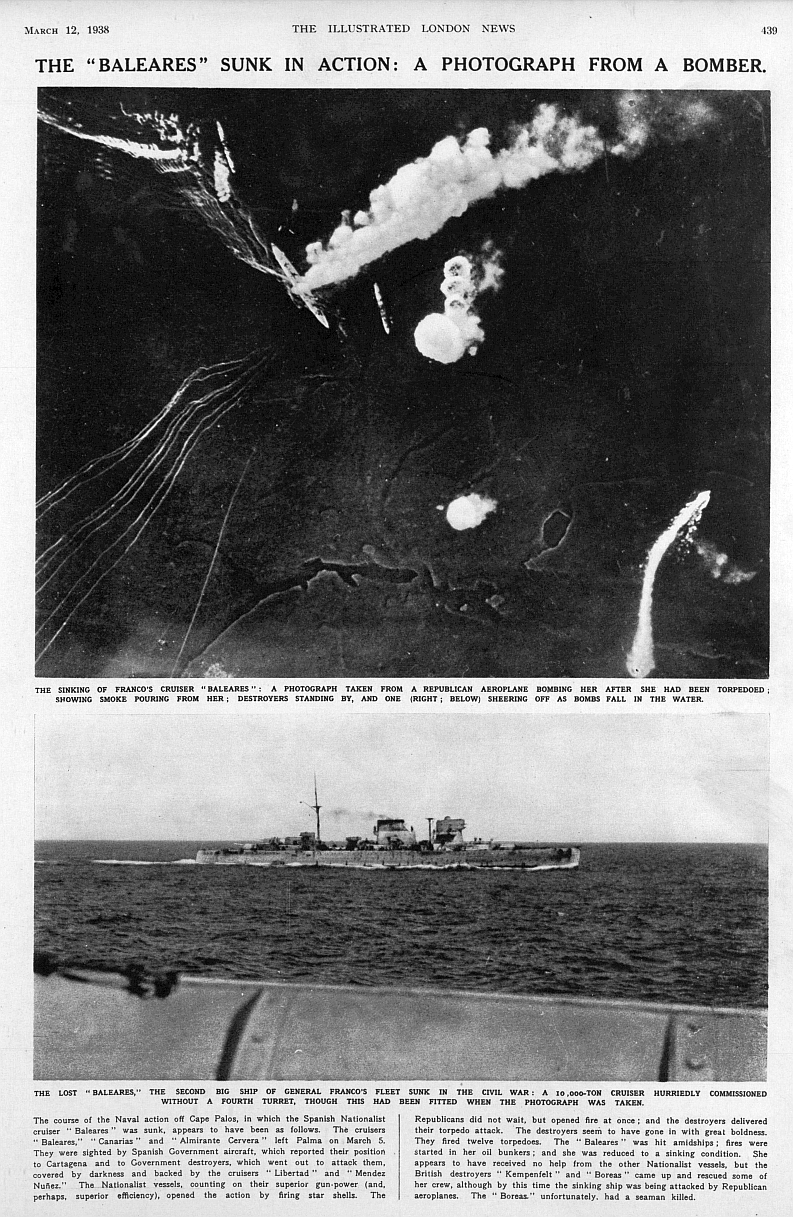
The "Baleares", second biggest ship in Franco's fleet, sunk in action
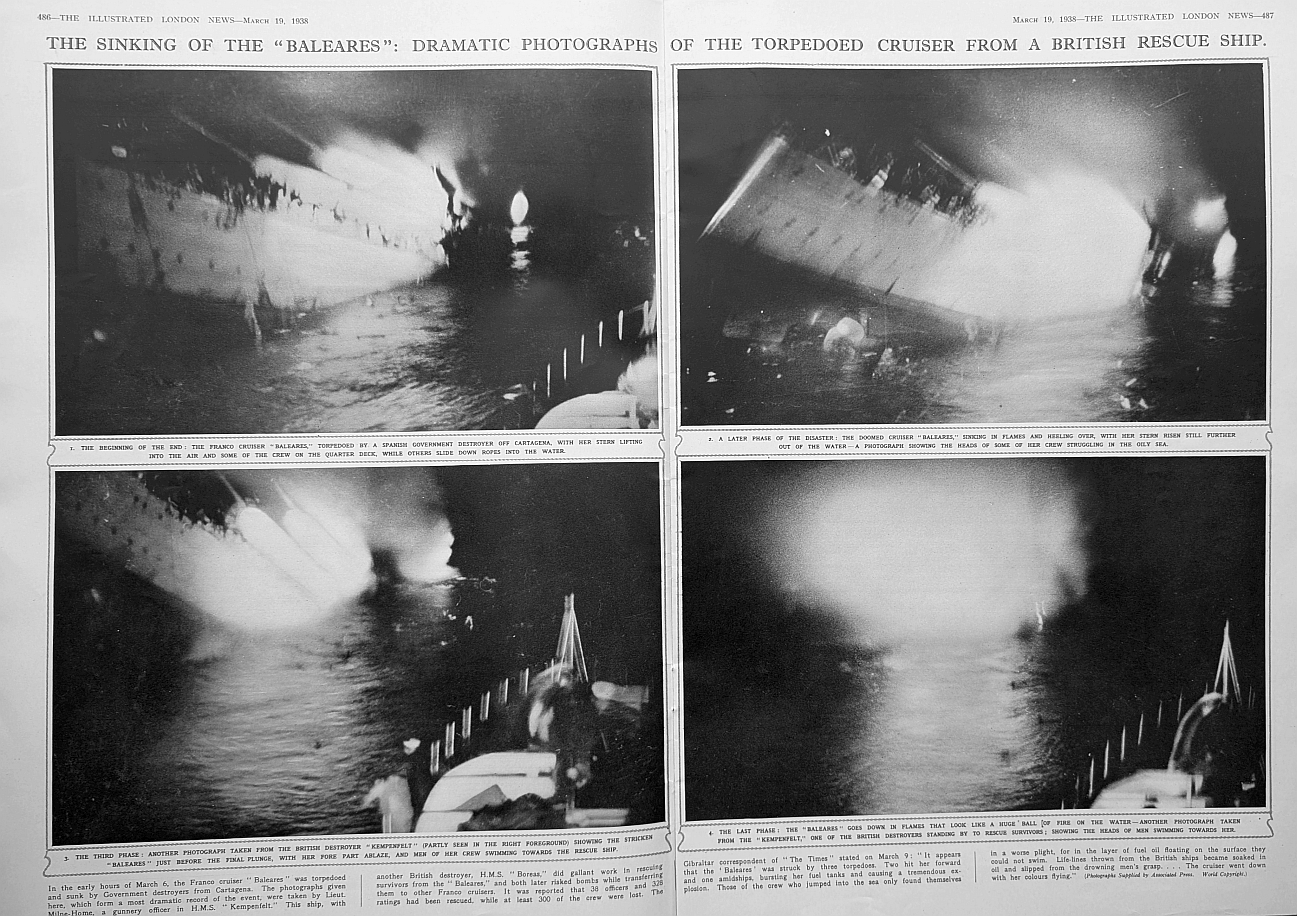
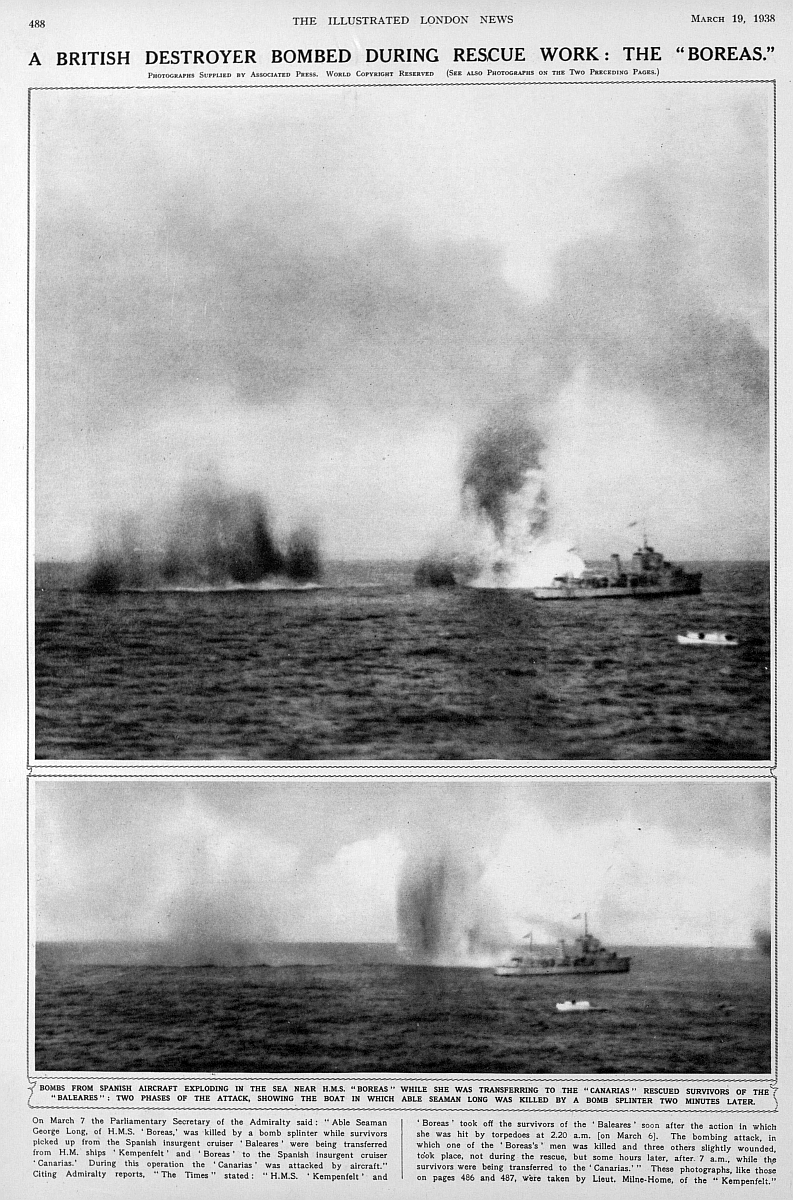
A british destroyer, "HMS Boreas" during rescue work on the "Baleares" March 19th 1938
Short historical note
The war was fought on multiple fronts and combined conventional battles with sieges (Guernica, Madrid, Bilbao) and aerial bombardment (notably Guernica in 1937). It ended in early 1939 with a Nationalist victory and Franco's long rule. The conflict was a testing ground for new military tactics and an ideological prelude to World War II.
- Preston, Paul. The Spanish Civil War.
- Beevor, Antony. The Battle for Spain.
- Contemporary ILN issues (scans on this site).