Extract From an article in The Illustrated London News May 13th 1967 by Peter Biddlecombe
ILLUSTRATED JOURNALISM was born 125 years ago this week. Queen Victoria
was celebrating two years of marriage and shocked by two attempts on her
life. She had made her first train journey and had her first child. Disraeli and Peel were at breaking-point Dickens and Thackeray were campaigning against public hangings;
and the Chartists were presenting their second petition
for reform. The whole of the new industrial North and Midlands were on
strike. Police forces of Yorkshire, Lancashire, and Staffordshire were
unable to cope. The military were drafted in to keep the peace. If ever
modem England seemed on the brink of civil war, says Sir Arthur Bryant,
it was then.
Yet in the midst of illiteracy and poverty—one in ten of the population
were paupers—printer, bookseller, and newsagent Herbert
Ingram had realised his life’s ambition. At 31, he was
creator of a new dimension in news gathering, architect of a revolution
in journalism, and founder and owner of the world’s first illustrated
weekly newspaper, The Illustrated London News. It was
the tombstone of pioneer reporting and the cradle of modern journalism.
In the history of his idea can be read a biography of the world
since 1842,
Born at Boston, Lincolnshire, in 1811, Herbert Ingram was the eldest son of an old impoverished
family that could be traced back to the days of James I. He was educated
at Laughton’s Free School and Boston Public School until he was
14. He was then apprenticed to Joseph Clarke, who ran
I a local printing business at the Market Place; when he was 21 he left
and worked in London as a journeyman printer for a year. In 1833, with
some money in his pocket, he teamed up with his brother-in-law, Nathaniel
Cooke, and opened in partnership in Nottingham as a printer,
bookseller, and newsagent. The business prospered. More and more customers
engaged their services for Herbert Ingram, who was the senior partner,
thought nothing of walking eight miles every Sunday to deliver a single
newspaper to please an insistent reader. In the early spring of 1842 he
convinced his partner that he had a good idea. He left his Nottingham shop to start a revolution.
Until Ingram, a stocky well-built man whose features looked remarkably like those of Napoleon, arrived in London the Press had been embarrassed by illustrations. They were perplexed and bewildered. In 1613 an early news sheet had carried a gruesome woodcut illustrating a story of “Three Bloodie Murders,” yet more than a century afterwards in 1731 the Grub Street Journal was still able to cause a sensation by printing a woodcut depicting the Lord Mayor’s Show. The 19th century newspapers were just as dilatory: The Times carried a woodcut of Nelson’s funeral car in 1806, The Observer illustrated the Cato Street Conspiracy in 1820—but not one of nearly 400 newspapers in the country, including 80 in London, realised the force and impact of illustrations until they were given the lead.
Ingram scored over other newspaper owners for he had
already studied his journalism from the grass roots for nine years before
making a move-Standing behind his newsagent’s counter in Nottingham he learnt two important lessons. The Weekly Chronicle always sold more copies when it carried illustrations—he remembered
the demand in 1837 when it carried illustrations and
reports of the Greenacre murder in Camberwell—and
his customers always wanted to know which newspaper contained the London
news.
Shortly after his arrival in London, Ingram contacted Henry Vizetelly, who had much experience in printing illustrations,
and Frederick Marriott of the Weekly Chronicle. He invited
them to discuss his brainchild over lunch at Truman Hanbury Buxton’s Old Cock Tavern, for centuries the Fleet Street haven of everyone from Goldsmith to Nell Gwynn and Samuel Pepys to Sheridan. As Ingram
planned his newspaper, Dickens, who as a dying genius
was to eat his last meal in public at the Tavern, was just being captivated
by its memories and menus. Vizetelly stressed the need for a newspaper
with a wide appeal. Marriott was less concerned, quarrelled with Ingram
before the first issue was even published, and ended up by launching the San Francisco News-letter.
Ingram faced two problems. First he had to find first-class artists and wood-engravers who would descend to journalism. Wood-engraving was a dying art restored to life, During the 18th century it would have disappeared but for the efforts of Thomas Bewick. In the early part of the 19th century it was practised by a handful of craftsmen who would now and again be asked to make a wood-engraving for The Observer, Bell’s Life of London, or the Weekly Chronicle. The artist’s picture would be pencilled on to the smooth surface of a number of pieces of boxwood. The engravers would cut away all parts of the wood except for the lines which composed the picture. The pieces were then assembled side by side so that they recomposed the picture and were locked tightly together with brass bolts and nuts. There was no urgency. An engraving might be published weeks after the actual event had taken place. Ingram now had to take a laborious and time-consuming craft and force it into the 19th-century. For the first time it was to experience the demands of news and deadlines.
Then he had to find journalists. Defoe, Swift, Steele, and Addison, the giants of 18th-century journalism, had set a hard standard to match.
John (later Sir John) Gilbert, a leading draughtsman
of the day, agreed to Ingram’s project and became the first artist
to descend to the higher profession. His friends quickly followed: Birket
Foster, a 27-year-old landscape painter, Harrison Weir and Alfred Crowquill, who used to illustrate the Bow
Street police reports. Later came Kenny Meadows, H. G. Hine, Charles Keene, George Cruickshank, and
finally John Leech, who at 23 was becoming one of the
country’s leading humorous artists and “Phiz,”
Hablot K. Browne, who illustrated Dickens. Famous names in the
history of wood- engraving, W. J. Linton, Orn Smith, and Ebenezer Landells, completed
the world’s first newspaper picture staff.
Ingram chose a minor poet who also wrote on miscellaneous
subjects as his first editor, Frederick William Naylor Bayley—better
known as Alphabet or Omnibus Bayley.
He wore well- brushed but seedy dress-suits and snake-like ringlets. The
author of Curiosities of London, John Timbs became his assistant. Offices were taken at Crane Court,
the works of Palmer & Clayton, the printers. A temporary
publishing office was established at 320 Strand, which
has now been absorbed by Bush House.
Work began in earnest on the first issue. Publication was delayed until May 14th so that they could cover Queen Victoria’s fancy dress ball at Buckingham Palace, the talk of the city. At the last minute came news of the Great Fire of Hamburg. There were no picture agencies to be ready with photographs—Ingram sent to the British Museum for a print of Hamburg. Artists quickly prepared the illustration, added smoke, flames, and onlookers, and the first issue of The Illustrated London News—16 pages, 32 engravings, and costing only 6d—was on sale.
To readers brought up on the dull, graveyard appeal of the Weekly Chronicle, it was a revelation. While The Times, with its new editor, John Delane, and other newspapers carried advertisements on the front page, Ingram began by breaking every rule in the book, He banished advertisements to the last three pages. At the top of the first page he placed a design of St Paul’s Cathedral with Lord Mayor’s processional barges gliding along the Thames. The Hamburg fire was on page one. John Gilbert’s drawings of the great masked ball were inside. And there were reports of a train crash in France, and war in Afghanistan, reviews of fashion and books.
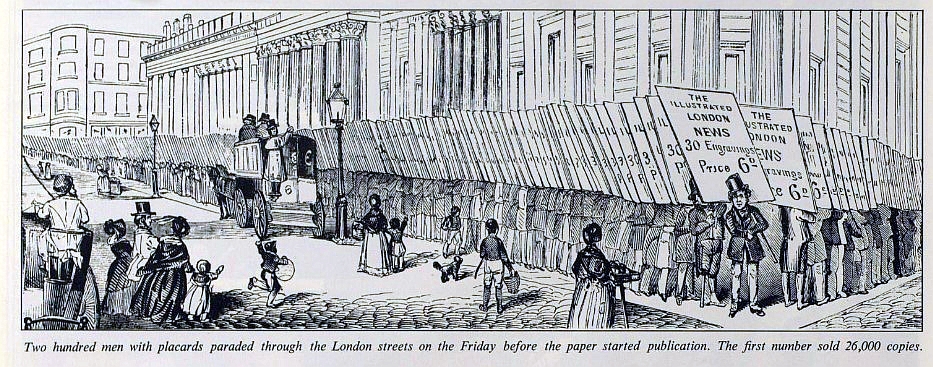
The response was enormous, The first issue sold 26,000 copies. Within
weeks sales grew to 40,000 and by the end of the year the paper had sold one million copies. Its circulation had grown to more
than 60,000 a week although the whole business was being
conducted from a single room on the second floor of 198
Strand, overlooking St Clement Dane’s.
Ingram was ready to launch a serious rival to Punch.
He also started promoting the paper. When it carried a picture of a new
archbishop, every clergyman in the country received a free copy. Readers
who took the paper for the first six months were promised a “Grand
Colosseum Print—views of London towards the North and the South.” This last caused a sensation and sales soared higher still.
Ingram never relaxed his concentration on the paper itself, He now began
the 50-year search for an alternative to wood blocks which was eventually to end with the introduction of halftones. Jabez Hogg was engaged to experiment with various methods of
trying to transfer daguerreotype photographs on to a
prepared wooden surface for reproduction. Ingram was also dissatisfied
with the paper The Illustrated London News used for printing,
He wanted a paper which would reproduce his wood blocks better than ever
before, He found there was only one solution: he started his own paper
mill.
Mark Lemon, hack dramatist, inn- keeper, and one of the
founders of Punch, now became Ingram’s private secretary.
He also had the dubious distinction of appearing as a very natural Falstaff in an illustration submitted to the paper by John Tenniel,
in his pre-Alice period. Gilbert Abbot a Beckett,
a fluent journalist—he had started seven newspapers and seen them
all die by the time he was 24—joined as leader-writer and contributed
many clever, witty articles. He also did a great deal to establish the
reputation of the paper in those early days. Ingram engaged Howard
Staunton, the famous chess-player, to write
the world’s first regular chess column and for 20 years he was idolised
by every enthusiast of the game. Staunton specialised in sarcasm with
a strong Shakespearean flavour and quarrelled with nearly
everyone, but the game benefited enormously by his attention.
The paper now rallied to Charles Dickens—he had
just published A Christmas Carol—and supported his campaign
for education and enlightenment for working people. It carried a picture
of him, wearing his “magpie waistcoat, speaking to 1,300 people
in Liverpool and afterwards receiving tumultuous applause.
By 1846 Charles Mitchell, publisher of the Newspaper
Press Directory, was able to comment, “The Illustrated
London News is liberal in its general tone, exactly suited for a
family paper . . it has more circulation among the younger generation
than any other newspaper.”
The year 1848 was a watershed for Ingram. The paper had sold 20
million copies in six years and was selling 80,000 copies a week.
His partnership with Cooke was dissolved. Omnibus
Bayley left and was replaced as editor first by his assistant
then by Charles Mackay, a first-class musician. Revolution broke out in France and gave the paper a chance to flex
its muscles.
London was hungry for news. Constantin Guys was despatched to Paris with instructions to send rough
sketches back to London as quickly as possible. Henri-Sulpice
Chevalier, better known as Gavarni, was engaged
to give them the finishing touches before they appeared. Anti-French feeling
was running high and the public seized every copy they could.
Storms of a different kind now enveloped the paper. They printed a woodcut
illustration of Millais’s Christ in the House
of his Father and horrified thousands of readers by criticising”
its intentional deformities such as the frostbitten toes of Joseph and
the sore heel of the Virgin.” The editor also discovered that he
had been publishing letters with the signature P.R.B.,
without realising he was lending the paper’s name to the Pre-Raphaelite
Brotherhood, whose members were rebelling against traditional
art.
In 1851, the year of the Great Exhibition,
the paper carried its first real scoop on the home front. The Illustrated
London News obtained and printed Paxton’s
designs for the Crystal Palace in Hyde Park before even Prince Albert had a chance to see them, let alone approve
them. The staff followed this up with every detail of news on the technical
achievements on show. The leader-writer rose to the occasion with bewildering
enthusiasm: “Who shall say if we had had a railway system pervading
Europe in 1780, and steamships plying between New York and Liverpool at the same period, whether Napoleon
Bonaparte might not have become a great sculptor or a great cotton-spinner
in 1810; whether Wellington, the mighty captain, might not, thirty years
ago, have been a philosopher greater and more genial than Bentham,
or a Lord Chancellor more potent and more profound than Eldon:
whether a thousand battles might not have remained unfought; and whether
the millions of men that perished in them might nut have helped to adorn
and improve a world which they were solely engaged in ravaging?
Sales rose to 130,000 copies a week. Even Queen
Victoria —according to her biographer—eagerly awaited
her copy each week. But music hath charms to soothe even the technocrat
of 1851. At Ingram’s suggestion, Mackay began a series of musical supplements containing songs he had adapted
to especially arranged melodies by Sir Henry Bishop.
The following year the Duke of Wellington, the idol of
early-Victorian England, died—and gave the paper another rise in
circulation. Copies carrying illustrations of the Iron Duke’s funeral—two still stand sentry over the funeral gun-carriage in
the crypt of St Paul’s cathedral pushed the figure
to 150,000 a week.
When the Crimean War broke out in September 1853 Herbert Ingram was more than ready for action. He dispatched six war artists, O. W. Brierly, J. W. Carmichael, J. A. Crowe, E. A. Goodall, G. H. Thomas, and Constantin Guys, to the front; for good measure he also published engravings of photographs taken by Roger Fenton, the world’s first war photographer. The artists became the first correspondents to accompany an army at war and send back reports. For three years readers were able to follow the Siege of Sevastopol, the assaults on the Redan and the Malakoff, and the battles of Balaclava and Inkerman in drawings and photographs. War had never been reported in such depth.
More records were established in 1855. Stimulated by the abolition of the penny newspaper stamp, sales rose to 200,000 copies a week in spite of 168 new newspapers being launched within I2 months and the Manchester Guardian and Yorkshire Post becoming dailies. It was 25 years before any other publication could reach the same circulation figure. The paper was making a profit of £12,000 a year and to celebrate Ingram published a Christmas supplement of colour pictures.
This was the signal for competition. Henry Vizetelly, Ingram’s earliest adviser, Andrew Spottiswoode, the Queen’s printer. and David Bogue, the publisher, with the help of Birket Foster, Kenny Meadows, and “ Phiz” launched the Illustrated Times, at less than half the price of The Illustrated London News. But they lacked Ingram. The paper had a brief success, bowed to the competition and was promptly swallowed by the ILN—Ingram paying Vizetelly £4,000 for his share.
By now Herbert Ingram was a powerful figure. He was
not only running the most successful newspaper in the country but he could
buy and sell other people and other publications. This made nonsense of
the early rumours emanating from Punch that every Saturday night
the Ingram family would sit around the table and have a good cry over
the week’s losses.
Ingram had power. But he wanted responsibility. On March 17 1856 he was
elected Liberal MP for Boston, his home
town. By December, with the circulation still hitting the magic 200,000 figure, he published—111 years ago—the world’s first
colour supplement. He was now producing a paper that was part of the intellectual
excitement of the times.
Peter Cunningham, author of Hand- book to London,
was writing “Town and Table Talk on Literature and Art.” Shirley
Brooks, a future editor of Punch, followed with “Nothing
in the Papers.” And in 1859 the verbose, colourful, yet very popular George Augustus Sala began writing regularly on literature
and art. A short, heavy man, known as “Fleet Street’s most
prominent landmark,” he wrote a gossipy “Echoes of
the Week” for more than 23 years. His elaborate, picturesque
prose has never been matched. Neither has his nose, which was “like
nothing else in the civilised world. It was a potato of a nose, a very
gargoyle of a nose.”
Ingram now had enough money to buy the copyright and plant of the London
Journal, a weekly illustrated newspaper of stories and romances,
for £24,000. The founder of illustrated journalism was laying plans
for the future—but within a year he was dead.
In 186o he left with his eldest son, Herbert, for Canada partly for a holiday—partly to provide illustrations for the Prince
of Wales’s North American tour. He was 49 and at the height
of his powers. The pair were travelling along Lake Michigan on the paddle-steamer. Lady Elgin, when she was rammed by the
schooner Augusta. The steamer sank. Three hundred passengers
lost their lives—including Herbert Ingram and his son. Ingram’s
body was taken back to England and buried in Boston on October 5th. On October 6th The Illustrated London News carried
a picture of “The late Mr. Herbert Ingram, MP for Boston—from
a photograph by John Watkins” On the opposite page
were two illustrations showing the Lady Elgin, before “she
was lost,” and the schooner, Augusta, afterwards. Two years
later Boston erected a statue to Ingram’s memory.
Herbert Ingram was a man born before his time. He was a prototype Northcliffe. He had the ideas, the verve, the understanding and appreciation of the Press. He had the same keen mind and powers of organisation. But two points were against him: the stamp duty, which was not relaxed until 1855; and time. He died at 49. Northcliffe died at 67.
But without Ingram, there would have been no Northcliffe. For Alfred
Charles William Harmsworth was once the £2-a-week editor
of Youth, which was published by Ingram’s son, William.
The organisation gave him his first opportunity of mixing with editors,
artists, writers, wood engravers, electrotypers, distributors, and advertising
men. His official biographers comment:
“He made the most of it.” It also, no doubt, helped him to
save the £1,000 he used to launch Answers, the weekly penny
paper which became his first success. However Northcliffe,
the master-mind of modern journalism, never understood the appeal of pictures.
After learning printing he failed to learn the lessons which Ingram had learnt behind his newsagent’s counter in Nottingham:
papers sell much better when they carry pictures. Ingram persuaded journalists
to produce a paper people wanted to buy. Northcliffe persuaded people
to buy a paper journalists wanted to produce.
On Ingram’s death control of The Illustrated London News organisation
passed to his widow (later Lady Ingram-Watkin), who held
the reins for 12 years until her sons, William and Charles, were old enough to take over as joint managing
directors. William, the second son, followed his father and became MP
for Boston. He was created a baronet in 1893 and died in 1924. Charles,
the third son, became co-manager and managing director and died in 1931.
On December 29th 1860 the ordinary wood-engraving and
photo-mechanical processes were fused for the first time.
The result: the first illustration ever published in
this country engraved from details photographed direct onto the surface
of a wood block. Henry Vizetelly was
working for The Illustrated London News again and it was carrying
reports from his brother, Frank, who was a correspondent-artist
of Garibaldi’s successes in Italy.
The following year he covered the American Civil War—from
both sides.
Circulation hit a new record in 1863, when the special issue marking the marriage of the Prince of Wales, later Edward VII, sold no less than 310,000 copies. By now The Illustrated London News was part of the social fabric: the country might listen to the thunder of The Times but it looked at The Illustrated London News. This strength enabled the paper to attract writers such as Edmund Yates, T. Hall Caine, Clark Russell, Robert Buchanan, Walter Besant, Clement Scott, James Payn, Andrew Lang, Andrew Wilson, Robert Louis Stevenson, George Meredith, Rider Haggard, Thomas Hardy, J. M. Barrie, William Black, Conan Doyle, and Rudyard Kipling.
The paper’s appetite for news was insatiable. In 1865 it carried illustrations showing the police attack on cock- fighting; in 1867 it showed British troops searching for Fenians in Tipperary; in 1868, the Abyssinian war; in 1870 the Franco-Prussian war. Five artists composed the paper’s own Press corps: William Simpson, who had just returned from Abyssinia; R. T. Landells, who was to win the Prussian Order of the Iron Cross; G. H. Andrews; C. J. Staniland; and Jules Pelcoq, who I was confined to Paris and forced to send both his drawings and photograph copies to London by balloon post.
In 1879 the Zulu wars broke out. Immediately Melton Prior, the artist- correspondent who covered every war from the Ashanti wars in 1873 until his death in 1910, left for South Africa. He described the British burying their dead at the fatal field of Isandhlwana as the saddest sight he had seen in seven campaigns. He was among the party who discovered the naked body of the Prince Imperial of France, the eldest son of Napoleon III, who had volunteered with the British and was killed leading a reconnaissance party before the advance on Ulundi. Prior’s famous sketch of the final stand of the Zulus under Cetawayo was rushed 295 miles by horseback in 55 hours to the nearest port for dispatch to London.
News and drawings from the front were becoming more and more urgent.
The cheap newspapers were beginning to consolidate their grip: Reynolds
News was selling 50,000 copies a week while News of the World and Lloyd’s Sunday News reached 100,000.
But in covering national news The Illustrated London News was
still able to beat them hands down. At 6.30 am on Tuesday April
19th , 1881, the last of the Great Victorians died at
number 19 Curzon Street. Macaulay, Cobden, Thackeray, Mrs Gaskell, Dickens,
and Bagehot were already dead; Benjamin Disraeli, the first Lord
Beaconsfield, now joined them. For five days his body lay in
the house. Shortly after midnight nn April 23rd a plain hearse carried
his body to Paddington station. At 2.25 it left for High Wycombe. From then on George Augustus Sala “ became the eyes and ears of all who could not attend as he observed
the festivities.”
“Places of business were closed and all the houses had the blinds
drawn down,” wrote Sala. But with the reporter’s eye for colour
he added, “Toys and photographs of the great Earl were being vended
by the roadside; the arrival of Royalty was anxiously expected and the
crowds of people of every degree scattered about seemed to enjoy their
outing thoroughly.” He spotted Lord Derby who had
walked from the station having great trouble getting into Hughenden when
a policeman “ with Spanish ideas of gentility, refused to believe
that so great a nobleman could travel on foot.” In the churchyard
he noted the Buckinghamshire Volunteers and the Wycombe
Volunteer Fire Brigade keeping the path to the tomb clear and
the people off the graves “ although, in fact, but little was needed
to restrain the throng, which was throughout, not orderly merely, but
reverent. Yes it was, with one exception, the most beautiful and the most
touching funeral that I have beheld.” Only Mr Gladstone it seems, remained unmoved. Suffering from an attack of diarrhoea, he
grumbled, “As he lived, so he died— all display, without
reality or genuineness.”
The Zulu wars were really only a dress rehearsal for
the Sudan, the first real Press war. The Mahdi revolted against British rule in 1883. Gordon, who had
been sent to withdraw Egyptian troops, wrestled with the problem. And
when the Gordon Relief Expedition reached the outskirts
of Khartoum in January 1885 artist- correspondent Melton
Prior was on the spot. He had marched with the column and reported
the desperate progress of the expedition for the readers of The Illustrated
London News.
Another artist-correspondent and veteran of 53 campaigns, Frederic
Villiers, described the scene:
“ When the sun rose on our camp so hushed was the little fort that
the reveille brought no wanted stir. From mouth to mouth was whispered,’
Khartoum has fallen.’ All our fighting, all our maddening thirst,
all our waste of precious blood and weeks of misery had availed nought.
Our advent on the Nile had been the signal for the sack of Khartoum and
Gordon’s doom.”
Churchill, of course, summing it all up much later,
had to have the last word. “Yet in this dark hour, there dawned
a brighter day,” he wrote.
Thirteen years afterwards Kitchener, avenging Gordon’s
death, began the reconquest of the Sudan. The Times sent Colonel
Frank Rhodes, a brother of Cecil. The Post engaged a
lieutenant of the 21st Lancers, Winston Churchill. And The illustrated London News, the only weekly represented, had Frederic
Villiers. By then he had become a legend among newsmen covering
the Russian—Turkish War of 1877 - 8. After the
Russian defeat he had helped the wounded and finally reached Bucharest clinging to an ambulance. Unwashed and plastered in mud he immediately
walked into the bar at the Brofft Hotel and shouted “Waiter,
quick, dinner. I’m beastly hungry.” Four years earlier during
the “Comic-opera war” between the Greeks and Turks he would
ride out from Volo to the battlefield each day in a carriage
in which he carried a bicycle and a camera.
Back home The Illustrated London News was publishing an advertisement
showing Queen Victoria in the royal train drinking Cadbury’s
cocoa; illustrating the riots and demonstrations against unemployment;
and preparing for the 20th century and the gradual change from the hand-engraving
of wood to the photographic reproduction of halftone. The circulation
of morning and evening newspapers in London probably totalled no more
than 750,000 and even if one added the daily Press for the whole country
the figure would still only be one million. But the Press explosion was
in sight. Oscar Wilde sensed the change in 1889 when
he said, “Newspapers have degenerated. They can now be absolutely
relied upon.” The Daily Mail was launched on May 4 1896. It immediately
sold 400,000 copies, not far short of the combined total of all London
penny papers. The same year, thanks to Jack the Ripper,
Lloyd’s Sunday News became the first newspaper to reach the one-million
circulation figure.
Queen Victoria's Diamond Jubilee provoked Sir
Walter Besant in The Illustrated London News to draw
the lesson of the 60 years since 1837. “ The broad Atlantic,”
he wrote, “has, indeed, become a mere pond. The wooden vessel looks
almost as antique as the caracks of the Armada.
Iron has come to rule supreme; steam has made the picturesque sails of
60 years ago as old fashioned almost as the trireme.”
The turn of the century marked more than 50 years of loyal service for
wood-engravings. Photographs began to replace drawings and the grandson
of the founder, Bruce Ingram (later Sir Bruce), replaced Clement Shorter as editor. He was just 22 years old but
destined to hold the post as editor for the 63 years until his death,
a record in British journalism.
Bruce Ingram faced a critical future. For the first time the daily Press
was a threat. They were able to scoop the weeklies with pictures. The
first daily picture paper, the Daily Graphic, had appeared in
1890 and within ten years it had become a very real danger. The Illustrated
London News decided to hit back by exploiting the weakness of the
daily Press and perfecting the techniques in which they excelled: they
started printing better photographs on better paper and Ingram began to
develop the slow, expensive process of Rembrandt Intaglio for rapid printing.
Within a year he faced the first real test of his editorship. Queen Victoria
died on January 22 1901 at Osborne House on the Isle of Wight. Ingram
fielded an army of artists, led by R. Caton Woodville, A. Forestier, S.
Begg, Fred T. Jane, Charles de Lacy, Harold Wyllie, T. Walter Wilson,
and the two famous war artists, Seppings Wright, and the irrepressible
Melton Prior, who had recently returned from covering the Boer War alongside
Churchill, Kipling, and Conan Doyle. Between them, the 21 artists presented
the only fitting tribute to an epoch which began in 1837 and finished
as the funeral procession left Windsor Castle for the royal mausoleum
at Frogmore. Bruce Ingram’s Queen Victoria Memorial issues of February
1901 were important successes.
Like his predecessors, Ingram sought the leading writers of the day.
Joseph Conrad, who had published only Almayer’s Folly and The Nigger
of the Narcissus, wrote the Christmas story, “Amy Foster,”
in 1901. One ardent reader, a science-fiction enthusiast who had just
published The First Men in the Moon—H. G. Wells— dashed off
a quick note to another young writer, Arnold Bennett, saying “very
interesting” and urging him not to miss it. Four years later Ingram
selected another young writer who had been practising journalism for only
six years, G. K. Chesterton, to write
Our Notebook.”
“G. K.” was a born journalist. He was able to write any time
and anywhere. He could write in railway stations, in bed, under a lamp-post,
or on top of a bus. He would think nothing of stopping half way up the
stairs to his flat in Battersea and completing a paragraph or finishing
a column in a Fleet Street pub. In 1907 he was insisting there was no
such thing as education. Then he would argue the pros and cons of high
and low church, report the death of Pius X, and outline the merits of
the Book of Job. In 1912 he caused an outcry with his statement:
“Sport has silently and subtly reversed its old character. The essence
of the change is this; that man began with the comparatively generous
idea of killing wild beasts and has ended up with the comparatively paltry
idea of preserving them.”
The man who was orthodox wrote a very unorthodox column. Yet at one time
Ingram wanted a change. He contacted Arnold Bennett, who was flushed with
success, and offered him £300 a year to take over from Chesterton.
Back came the curt reply: Bennett wasn’t interested. He could earn
that money in one week. Perhaps Chesterton heard of this when he came
to write his
“Ballad of a Periodical”;
But I, whose copy is extremely late
And ought to have been sent on
now before,
I still sit here and trifle with my fate,
And idly write another ballade more,
I know it is too late: and all is over,
And all my writings they will now
refuse,
I shall be sacked next Monday.
So be sure
And read The illustrated London News.
The war to end all wars broke out on August 4 1914; on August 8 The Illustrated
London News published a special double number. Frederic Villiers was already
at the front, having trained for the assignment by riding in Hyde Park
every morning. He was quickly followed by Julius Price, who had travelled
between the Arctic coast of Siberia and Australia in the search for news,
and Seppings Wright, who had covered seven campaigns. Home news reported
the Stock Exchange closed, Bank Rate abnormal, and war clouds gathering.
There was a plan of the German and French frontier forces, a picture of
a lonely Prince Lichnowsky, the German Ambassador, who had just been handed
his passports, and the first studio portrait of Princess Mary
“photographed at Buckingham Palace for the first time since her
hair was put up and her skirts were lengthened”.Week by week the
paper followed every development and crisis, every victory and defeat.
On Fridays the organisation published The Illustrated London News and
on Wednesdays The Illustrated War News, a special pictorial history.
In January 1916 Bruce Ingram left his editorial chair for the front line.
In three years’ active service with the Royal Garrison Artillery
in France, he gained the Military Cross and was mentioned in dispatches
three times. He returned at the end of the war and after the General Strike
and the Great Depression celebrated the centenary of The Illustrated London
News on April 30 1932— ten years early. He anticipated the Second
World War, and decided he could not afford the risk of waiting the ten
years for the actual date. As events turned out he was right.
G. K. Chesterton, now in his 27th year as a contributor, summed up the
achievements of the paper. “It has outlived many institutions, both
public and private, which the public who read it first regarded as being
normal to the nation and even to the nature of things,” he wrote.
“ It has outlasted the Act of Union, the State Churches established
in Wales and Ireland, the Penny Postage, the Three Volume Novel, the Gold
Standard and the great wealth of the landed gentry.”
Within seven years Chesterton was dead, Sir Arthur Bryant had taken over,
and war was being declared again.
On September 2 1939 the paper’s first report of the Second World
War was published. “The Modern British Army; a Force prepared, equipped
and trained for service abroad,” ran a two- page headline. There
were photographs of defence preparations, the men responsible for defence,
and the nation’s leaders; Bryan de Grineau, before he was appointed
official war artist, showed the scene in Parliament on August 24 when
Chamberlain addressed the House; other drawings showed “the former
Conservative critics of Mr. Chamberlain’s policy, Mr. Churchill,
Mr. Duff-Cooper. . . Mr. L. S. Amery... and Mr. Eden.” But the issue
was dominated by a two-page picture of Hitler addressing the secret session
of the Reichstag on August 27. The caption read: “ The first hint
of his presence came in a communiqué’s last line; ‘At
the end of the address, which gave evidence of the situation’s gravity,
the Fuhrer was enthusiastically cheered!’”
On May 16 1942 Bruce Ingram celebrated his paper’s actual centenary,
but was unable to mark the occasion as be would have planned. The paper
that had delayed its launch because of a masked ball at Buckingham Palace
now bad to restrict its 100th-anniversary celebrations because of a paper
shortage.
The 50s were the glorious 50s: the demands of a Festival of Britain, a
Coronation, and the 8oth birthday of that rival correspondent of the Sudan
wars were met. The paper also faced its strongest competing medium with
the advent of television—but the fleeting impact of the moving picture
had little or no effect on sales. In the middle of the 20th century Herbert
Ingram’s theories stood their ground.
The special Festival of Britain issue presented a definitive guide to the exhibition complete with photographs and drawings prepared by Bryan de Grineau and G. H. Davis. The death of King George VI nine months later was marked by another special number. “The lot of King George VI was not cast in an easy time,” wrote Sir Arthur Bryant. “No Sovereign of his dynasty ever witnessed so much public adversity, either during his reign or in his lifetime. To find a parallel one would have to go back to the troubled days of the 17th century or earlier.”
Within a year the paper was celebrating the Coronation. On May 30 1953
Sir Arthur Bryant, in a mellow, reflective mood wrote,” My first
Coronation was in 1902. But I was still under four and my memory of that
occasion is neither extensive nor reliable. So I have turned to the copy
of The Illustrated London News whose pages I must first have turned a
few days after the event as I lay on the nursery door, and have gazed
again, after a lapse of half a century, at the pictures of that resplendent
event and the letterpress accounts of it.” Both Adrian Brookholding
Jones and Bryan de Grineau prepared drawings, and Sir Bruce rounded off
the issue with an account of Captain Blood’s abortive attempt to
steal the Crown on May 9 1671. The following week Bryant was more jaundiced.
“Modern Coronations are like modern Cbristmases; everyone takes
part in them; everyone rejoices at them, and nearly everyone, despite
a wealth of printed and broadcast clerical reminders, tends to forget
or ignore their real purpose,” he wrote.
The year 1963 marked the end of an epoch in modem journalism: Sir Bruce
died in his 63rd year as editor. He had been editor for half the life
of the paper. Under his lead, it had adjusted to the 20th century and
kept pace with modern developments without sacrificing its traditional
features. His cousin. Hugh Ingram now assumed control and The Illustrated
London News passed into the bands of the fourth generation of the Ingram
family. Assistant editor for more than 20 years, he knew the paper and
its readers intimately. News coverage and features remained as comprehensive
as ever, but month by month he made adjustments that kept pace with the
latest trends.
Two years later a young editor from Life magazine, Timothy Green, took
over, and completed the process started by Hugh Ingram. Advertisements
were now swept off the cover and replaced by full-colour photographs.
The date has gone down in history: eight days before, Sir Winston Churchill
suffered a cerebral thrombosis following a cold at his home in Hyde Park
Gate, on January23 The Illustrated London News published their first cover
picture—a photograph of Sir Winston. The following week Churchill
was dead; a very I bleak and sombre front cover showed the Union Jack
flying at half mast over Westminster Abbey.
On February 6 1965 the paper devoted 40 pages of pictures and reports
to the most detailed and comprehensive record of the lying-in-state and
funeral. Paul Hogarth was the only artist to sketch the scene in Westminster
Hall on the first day of the lying-in-state when the watch was taken over
by Earl Mount- batten of Burma, Chief of Defence Staff, and the three
Chiefs of Staff. “Only twice before in our history, I think,”
wrote Sir Arthur Bryant, “has any funeral evoked such a sense of
universal mourning and national pride as that of this wonderful man.”
Today that issue is treasured more than any other. Parents keep it fur
their children, librarians guard it, and historians treat it as the definitive
record. Throughout the past 125 years this has always been proof of the
unique position held by the paper: it is universally conceded that other
newspapers report news; the nature of its brief permits The Illustrated
London News to report history.
Six months later came a further step to ensure that the paper enjoyed
the latest printing techniques available in the country. Sir Bruce Ingram
had developed the slow Rembrandt Intaglio process for rapid printing,
later his paper became the first publication to use rotary photogravure;
on August 7 1965 it switched to heatset web offset.
On March 15th 1966, following the interregnum after Sir Bruce’s
death, the present editor, John Kisch, took over. He is the tenth editor
in 125 years. The picture news coverage has been consolidated. New writers
including Robert Blake, Peter Kirk, and C. Northcote Parkinson have joined
the regular contributors. Dr Maurice Burton continues to write on zoology
while Edward Hyams takes care of gardening. Sir Charles Petrie and lain
Hamilton share the non fiction reviews; J. C. Trewin and Alan Dent write
about the theatre and cinema.
Those who have followed Herbert Ingram have followed one of the few creative
talents in the newspaper industry. And those who have served The Illustrated
London News during the past 125 years have served one of the pioneer newspapers
of the world.
Two hundred men with placards paraded through the London Streets on the Friday before the paper started publication. The first number sold 26,000 copies