The "First Boer War" (1880–1881),
also known as the ""First Anglo-Boer War"" or the ""Transvaal War"", was a brief but significant conflict between the British Empire and the Boer settlers of the ""South African Republic (Transvaal)"". The war was triggered by British imperial ambitions in Southern Africa and the Boers' desire to retain their independence. Here’s a detailed breakdown of the events and significance of the war:
""Background and Causes of the First Boer War""
1. ""British Annexation of the Transvaal (1877)"":
- The conflict’s roots lie in British expansionism in southern Africa during the 19th century. The Transvaal Republic was originally an independent Boer state, but in 1877, the British annexed it, citing the government’s financial difficulties and fear of local instability due to indigenous conflicts (notably with the Zulus).
- The Boers deeply resented British control, as they had fought for independence from British authority in the Great Trek during the 1830s.
2. ""Boer Resistance to British Rule"":
- The Boers disliked the British administrative and taxation systems and felt that British rule threatened their way of life and independence. The Boer population was largely agrarian, deeply religious, and fiercely independent.
- In 1879, British attempts to bring the Zulus under control (in the Anglo-Zulu War) further inflamed tensions. After the British defeated the Zulu Kingdom, the Boers feared further expansionist moves.
3. ""Rising Boer Nationalism"":
- The annexation and subsequent British rule led to a revival of Boer nationalism. Many Boers demanded a return to self-governance, and by 1880, they were ready to fight for it. The conflict became inevitable when Boer leaders openly rebelled.
---
""Key Events of the First Boer War""
1. ""December 16, 1880: The Start of the War"":
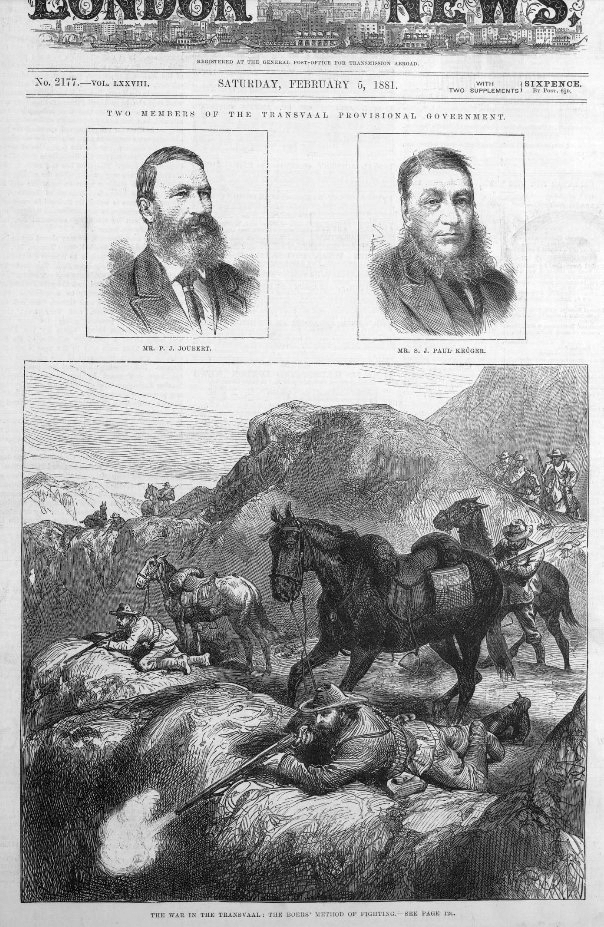
- The war began when the Boers declared independence from Britain and formed the ""Triumvirate"" government, composed of prominent Boer leaders: Paul Kruger, Piet Joubert, and Marthinus Pretorius.
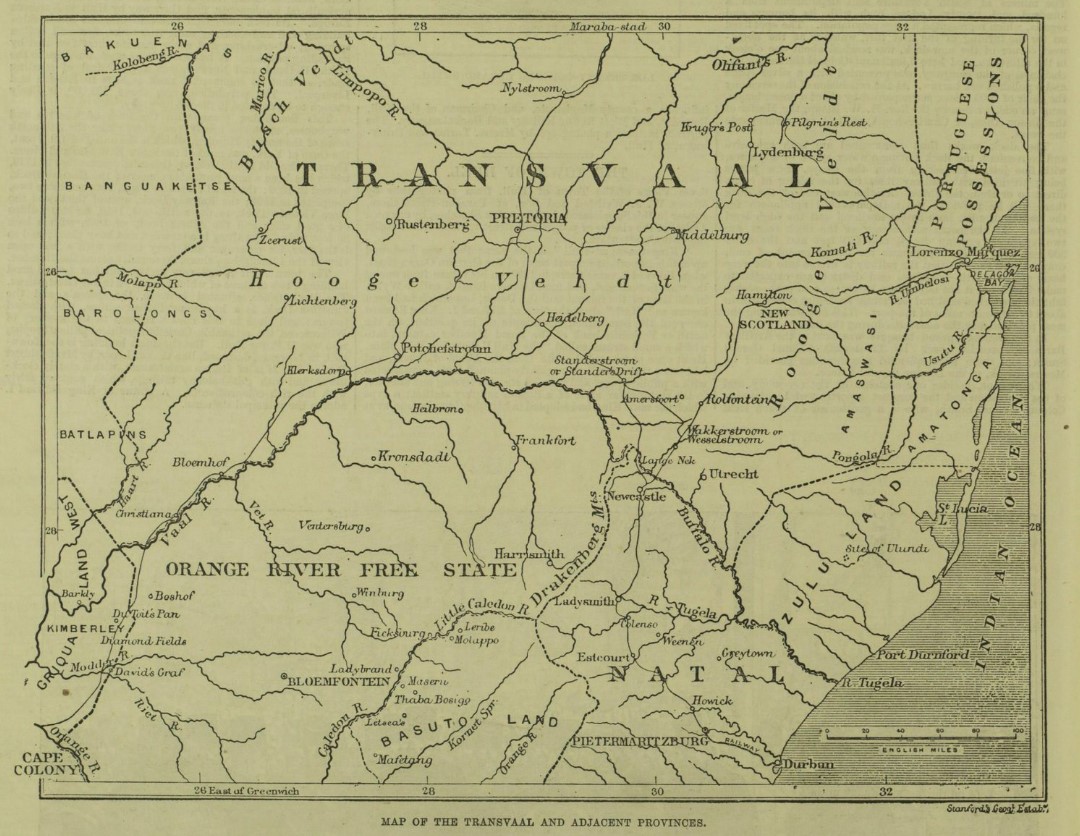
- On ""December 16, 1880"", the Boers raised the old Transvaal flag at ""Heidelberg"", signaling the start of the war. Shortly after, Boer commandos attacked British garrisons and disrupted communications.
2. ""December 20, 1880: Battle of Bronkhorstspruit"":
- One of the first major engagements occurred at Bronkhorstspruit, where a British convoy of 259 men, under Colonel Anstruther, was ambushed by a Boer commando. The Boers, with superior knowledge of the terrain and using accurate long-range rifle fire, defeated the British, killing or wounding over half of the British force. The Boers suffered minimal casualties.
3. ""December 1880 – February 1881: Siege of British Garrisons"":
- The Boers laid siege to several British garrisons stationed in towns such as ""Potchefstroom"", ""Rustenburg"", and ""Pretoria"". These sieges were relatively small in scale but demonstrated the Boers' determination and skill in using guerrilla tactics.
4. ""January 28, 1881: Battle of Laing’s Nek"":
- One of the major battles of the war took place at ""Laing's Nek"", where the British, under Major-General Sir George Pomeroy Colley, tried to break through Boer defenses and march on Pretoria. The Boers, using well-positioned defensive trenches and superior marksmanship, repelled the British assault. The British lost over 200 men, and Colley was forced to retreat.
5. ""February 8, 1881: Battle of Schuinshoogte (Ingogo Heights)"":
- In another engagement, the British tried to force a crossing at ""Ingogo Heights"". Poor weather and high Boer positions gave the Boers a decisive advantage, and after several hours of heavy fighting, the British were forced to withdraw with heavy casualties, leaving many dead and wounded on the battlefield.
6. ""February 27, 1881: Battle of Majuba Hill"":
- The most decisive battle of the war occurred at ""Majuba Hill"". British General Colley, hoping to break the Boer sieges and restore British prestige, occupied Majuba Hill, which overlooked Boer positions. Colley believed that holding the high ground would give his forces an advantage.
- However, the Boers launched a surprise assault, scaling the steep slopes of the hill and overwhelming the British forces. The British, caught off guard and poorly positioned, suffered a humiliating defeat. General Colley himself was killed during the battle, and the British suffered over 280 casualties, while the Boers only lost one man.
- The defeat at Majuba Hill was a crushing blow to British morale and marked the end of the war. It demonstrated the effectiveness of Boer tactics and their superior knowledge of the terrain.
---
""March 1881: Treaty of Pretoria and Aftermath""
1. ""Negotiations and Treaty of Pretoria"":
- The shocking defeat at Majuba Hill forced the British government, led by Prime Minister William Gladstone, to reconsider its position in South Africa. Gladstone had been reluctant to engage in the conflict and was inclined toward a more conciliatory policy.
- In ""March 1881"", a ceasefire was called, and negotiations began between the British and the Boers. The ""Treaty of Pretoria"" was signed later that year, granting the Boers self-government in the Transvaal under British suzerainty. The Boers regained control of their territory, although the British maintained nominal oversight of the region’s foreign affairs.
2. ""Boer Victory and British Humiliation"":
- The First Boer War was a significant victory for the Boers and a major embarrassment for the British Empire. Despite their superior numbers and military strength, the British were outmaneuvered by the lightly equipped Boer commandos. The Boers’ tactics of hit-and-run attacks, guerrilla warfare, and use of the rugged terrain gave them a distinct advantage.
- The British government, keen to avoid further costly and unpopular conflict, essentially conceded to the Boers' demands for independence in the Transvaal. The Boers, however, remained wary of British intentions, knowing that future tensions could arise.
---
""Significance of the First Boer War""
1. ""Boer Independence and Resentment"":
- The First Boer War reaffirmed Boer independence in the Transvaal and was a major assertion of their resistance to British imperialism. However, British sovereignty in the region was not completely dismantled, and the seeds of future conflict were sown.
2. ""Military Lessons"":
- The war exposed significant weaknesses in the British military, particularly in dealing with guerrilla warfare. The Boers' success with decentralized command structures and their intimate knowledge of the land contrasted sharply with the rigid British military tactics.
3. ""Prelude to the Second Boer War"":
- While the First Boer War ended in a temporary resolution, the underlying tensions between the British and the Boers remained unresolved. The discovery of ""gold"" in the Transvaal in 1886 intensified British interest in the region, and less than two decades later, the two sides would again go to war in the ""Second Boer War"" (1899-1902).
The First Boer War was a pivotal moment in the history of British colonialism and Boer nationalism, shaping the future political landscape of South Africa.
The Boer War (also known as the Second Anglo-Boer War) began in 1899 due to tensions between the British Empire and the two Boer republics in Southern Africa: the South African Republic (Transvaal) and the Orange Free State. There were several underlying causes for the conflict:
Causes of the Boer War:
1. ""British Imperialism and Expansion"": The British sought to expand their control in Southern Africa, particularly after the discovery of gold in the Transvaal in 1886. The British were keen on dominating the region’s wealth and resources.
2. ""Boer Independence"": The Boers (Dutch-speaking settlers) were determined to maintain their independence in the face of British imperial ambitions. They had already fought the British in the First Boer War (1880–1881) and retained their autonomy under a peace agreement, but tensions simmered.
3. ""The "Uitlander" Issue"": Many British immigrants (known as Uitlanders) moved to the Transvaal after the discovery of gold. These immigrants had limited political rights under Boer rule, and Britain demanded better treatment and voting rights for them. The Boer government, under President Paul Kruger, refused, increasing British frustration.
4. ""Jameson Raid (1895)"": A failed raid by British forces led by Dr. Leander Jameson attempted to incite an uprising among the British settlers in the Transvaal against Boer rule. Though unsuccessful, it worsened relations between the Boers and the British and made the Boers suspicious of British intentions.
5. ""Strategic Importance of South Africa"": The region was vital to British interests, both economically (due to its minerals like gold and diamonds) and strategically (as a key point on trade routes to India and the East).
Significant dates during the Second Boer War (1899-1902):

October 11th - Start of the second Boer War (Colonial Troops off to war)
1. ""October 11, 1899: War Breaks Out""
- ""Boer Ultimatum and Start of War"": The war officially began when the two Boer republics (Transvaal and Orange Free State) issued an ultimatum to Britain. They demanded the withdrawal of British troops from their borders and cessation of British military reinforcements. When the British rejected the ultimatum, the Boers declared war. This sparked the Second Anglo-Boer War.
- ""Boer Initial Successes"": In the early months, the Boers employed a mobile, guerilla-style of warfare, which gave them several early victories against British forces. Boer troops laid siege to key towns like Ladysmith, Kimberley, and Mafeking in British-controlled territories.
---
2. ""December 1899: Black Week""
- """Black Week" (December 10–15, 1899)"": During this week, British forces suffered a series of disastrous defeats at the hands of the Boer armies. These defeats exposed British military weaknesses and caused significant embarrassment back in Britain.
1. ""Battle of Stormberg (December 10, 1899)"":
- British forces, under General Gatacre, attempted to capture the Stormberg rail junction in the Cape Colony. However, they were ambushed by the Boers in unfamiliar territory, leading to over 700 British soldiers being captured.
2. ""Battle of Magersfontein (December 11, 1899)"":
- British General Lord Methuen tried to relieve the siege of Kimberley but was decisively defeated at Magersfontein. The Boer forces, under General Piet Cronjé, had dug trenches in front of the British advance and inflicted heavy casualties. The British suffered over 900 casualties and were forced to retreat.
3. ""Battle of Colenso (December 15, 1899)"":
- Under the command of General Sir Redvers Buller, British forces attempted to cross the Tugela River to relieve the besieged town of Ladysmith. Boer forces, led by Louis Botha, repelled the British, who lost over 1,100 men. This defeat was the final blow of "Black Week."
---
3. ""February 28, 1900: Relief of Ladysmith""
- ""Relief of Ladysmith"": Ladysmith, a British-held town in Natal, had been under siege by Boer forces since November 1899. After the disaster at Colenso, British forces under General Sir Redvers Buller launched several attempts to break through Boer defenses.
- On ""February 28, 1900"", after months of hardship, Buller's forces succeeded in relieving the siege of Ladysmith, marking a significant psychological victory for the British. The Boers withdrew after fierce fighting, and British forces entered the town. The successful relief of Ladysmith boosted British morale after the earlier setbacks.
---
4. ""May 28, 1900: Capture of Bloemfontein""
- ""Bloemfontein Captured"": Bloemfontein, the capital of the Orange Free State, was captured by British forces under Lord Roberts on May 28, 1900. This came after a successful advance following the relief of Kimberley in February and the British victory at the Battle of Paardeberg (February 18–27, 1900), where Boer General Piet Cronjé surrendered to the British.
- The fall of Bloemfontein marked a major turning point in the war, as it severely weakened the Boer republics. Lord Roberts' strategy of capturing key Boer strongholds and taking control of their capitals was proving effective.
---
5. ""June 5, 1900: Capture of Pretoria""
- ""Pretoria Captured"": Following the capture of Bloemfontein, the British continued their advance into the Transvaal. On ""June 5, 1900"", they captured Pretoria, the capital of the South African Republic (Transvaal).
- The capture of Pretoria was another major blow to the Boers, but it did not end the war. Boer forces retreated into the countryside and adopted guerrilla tactics, continuing to resist British occupation.
---
6. ""1901: Guerilla Warfare and British Response""
- ""Guerilla Warfare Begins"": By mid-1900, Boer armies could no longer fight large-scale battles, and their formal armies dissolved into smaller, mobile commandos. These commandos harassed British troops, sabotaged railways, and conducted raids on supply lines. This guerrilla phase of the war lasted from 1900 until the end of the war in 1902.
- ""British Scorched Earth Policy"": In response to Boer guerrilla tactics, the British employed harsh measures, including the destruction of Boer farms and crops (scorched earth tactics) to deprive the guerrillas of food and shelter. Over 30,000 Boer homes were burned, and crops were destroyed.
- ""Concentration Camps"": The British also established concentration camps for Boer civilians (mostly women and children) and Black Africans, aiming to cut off support for the Boer commandos. These camps became notorious for their poor conditions, with disease and malnutrition leading to the deaths of around 28,000 Boer women and children and around 20,000 Black Africans. This policy, while controversial, gradually weakened Boer resistance.
---
7. ""May 31, 1902: Treaty of Vereeniging""
- ""End of the War"": After nearly three years of fighting, the war officially ended on ""May 31, 1902"", with the signing of the ""Treaty of Vereeniging"". The Boers agreed to lay down their arms and accept British sovereignty. In return, the British promised that the Boers' property rights would be respected and that Dutch (Afrikaans) would be allowed in schools and courts.
- The treaty allowed for the eventual self-governance of the Boer territories. In 1910, the Union of South Africa was established, incorporating both the former Boer republics and British colonies under a single government.
---
Long-Term Consequences:
- The war was costly for both sides, with around 22,000 British soldiers and 6,000 Boers losing their lives. The use of concentration camps and scorched earth tactics left a deep scar in South African history, fostering resentment between Afrikaners and the British that would linger for decades.
- The war highlighted the need for military reform in Britain and contributed to changes in British imperial policy in the 20th century.
Let me know if you'd like to dive deeper into any specific battle or aspect of the war!
|

